Friday, October 15, 2010
Sustainable Development Weekly Updates Oct 08 - Oct 15 - Justmeans
All-electric buses are coming to a bus stop near you -- or at least, nearer than ever before.
China has led the way in electric bus utilization for many years, but now bus companies in the U.S. are testing and accepting a variety of all-electric transit vehicles. The relatively sleek, smooth buses offer the potential to save vast sums of operating expenses over the typical bus' operating life.
One reason electric buses are now appearing on local streets in the U.S. is that their batteries can be charged in just a few minutes, instead of the hours required by older energy-storage technologies.
Post continues: http://www.justmeans.com/All-Electric-Buses-En-Route-Sustainable-Development/33646.html
Sustainable Development Efforts Yield World's First Zero-Carbon City - Robert Moskowitz
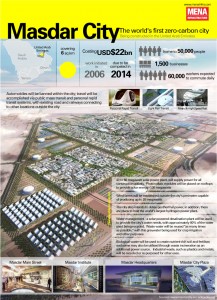
Masdar City, the world's only zero-carbon city, is still on track to be built in Abu Dhabi, despite massive changes in the world's economy.
The original project was projected to cost some $22 billion, and to be completed in 2016. More recent reviews considering the financial crisis indicate the advanced residential and industrial cluster may not be completed until 2020 or even 2025. However, the cityi's first phase is still on track to be ready for occupancy by 2015.
Post continues: http://www.justmeans.com/Sustainable-Development-Efforts-Yield-World-s-First-Zero-Carbon-City/34310.html
Financial Incentives for Sustainable Development - Robert Moskowitz
Although some have expired, a great many government tax incentives, credits and other financial rewards are still available for homeowners who wish to install some form of green energy system in their principal residence.*
These incentives are intended both to stimulate economic activity and reflect society's growing recognition of the potential dangers and problems caused by global climate change, dependence on foreign oil supplies, and other impending changes in our energy economy. Governments at the federal, state, and local levels are trying to incentivize their residents to install so-called "green" technology that does a better job of utilizing renewable energy sources and/or being more efficient in its use of energy, regardless of its source.
Post continues: http://www.justmeans.com/Financial-Incentives-for-Sustainable-Development/34321.html
Zinc Industry's CSR Initiative Helps Tackles Zinc Deficiency - Anna Dubuis

Zinc deficiency affects two billion people globally and contributes to the deaths of 450,000 children every year. Yet, just like other micronutrient deficiencies, it is often an invisible illness, and consequently as a public health issue it receives little attention. Zinc is an essential micronutrient for human health, helping to fight off illness, like malaria and diarrhoea, and is vital to children's cognitive development and learning. When diets do not contain sufficient amounts of zinc, the consequences include lower birth weight, a decrease in cognitive ability and increased susceptibility to other diseases.
As a major contributor to over 800,000 deaths each year, what is equally as shocking is that the majority of these deaths are easily preventable with a simple zinc supplement. UNICEF is one of the many humanitarian organisations that are providing zinc and other micronutrient supplements to children in developing countries. Just a few extra milligrams of zinc every day can be the difference between life and death.
Post continues: http://www.justmeans.com/Zinc-Industry-s-CSR-Initiative-Helps-Tackles-Zinc-Deficiency/34456.html
Water Reclamation Center Opens To Boost Environmental Conservation - Robert Moskowitz
A gathering of Wyoming's finest were on hand October 6, 2010, to witness the official opening of the new Red Desert Water Reclamation (RDWR) center. Designed to reclaim water polluted by use within the oil and gas industry, the RDWR facility brings a significantly higher level of environmental sustainability to the state. RDWR is located less than two hours by truck from a large number of multiple oil- and gas-producing basins.
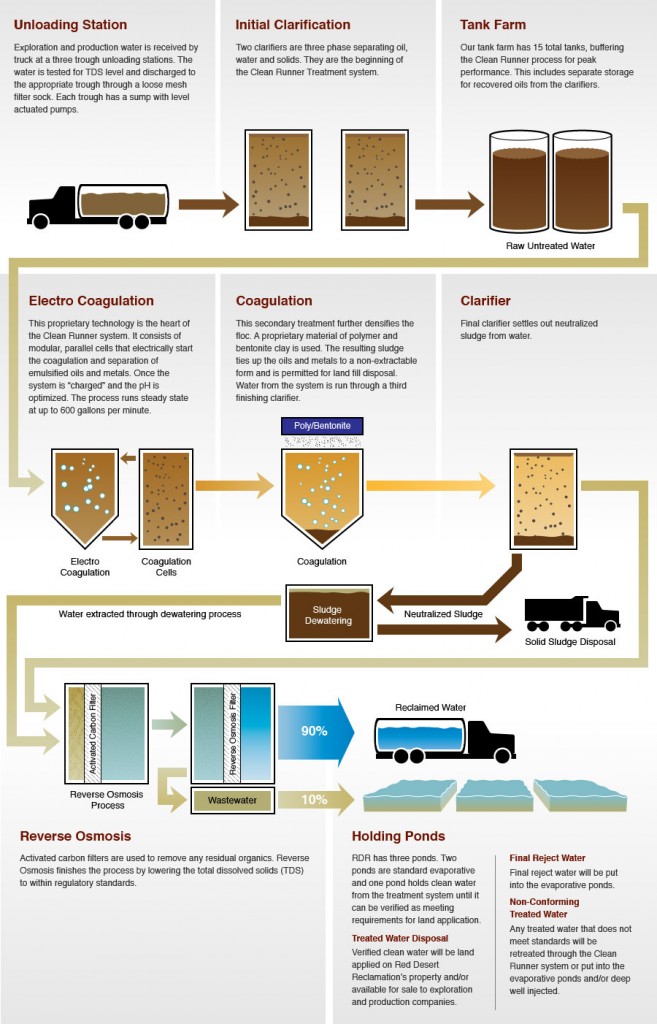
RDWR can treat approximately 20,000 barrels of water per day, using a chemical-free, low-cost technology to transform pollluted water that is currently lost through well-injection or evaporation methods into usable water that easily meets both U.S. Environmental Protection Agency and Wyoming's Department of Environmental Quality standards.
Incoming water is sorted on the basis of its Total Dissolved Solids, as much as 9000 parts per million (ppm), and isolated into tanks. It then passes through a system of clarifiers to remove suspended solids and floating organics, which are neutralized with a bentonite and polymer compound for disposal in a land fill. After clarification, the water goes through electro coagulation, flocculation and separation, and finally Reverse Osmosis. Fully cleaned, RDWR's reclaimed water can be used for irrigation or recycled for re-use in additional oil and gas production processes.
Post continues: http://www.justmeans.com/Water-Reclamation-Center-Opens-Boost-Environmental-Conservation/34487.html
Share and Enjoy:
Friday, October 8, 2010
Sustainable Development Weekly Updates - Justmeans
A new kind of expo, the Energy Efficiency Expo, is coming to town. It's a newly organized trade fair showcasing products and services to help organizations reduce their energy consumption and become more energy-efficient, and it's scheduled to be held October 18-20, 2010, at the Gaylord Texan Convention Center in Grapevine, Texas (near Dallas).
"Energy Efficiency has become a key focus for business, government and institutional organizations," said David Webster, president of the new event's producer, Webcom Communications. "Attendees will be able to see and learn about the many new products and services available that can help them reduce energy consumption, lower their energy bills and improve their green footprint. Some will even discover new ways they can turn energy-efficiency capabilities into revenue-generation tools for their organization."
Post continues: http://www.justmeans.com/Energy-Efficiency-Expo-Supports-Sustainable-Development/33634.html
Sustainable Development: Cleaning up the Kitchen - Anna Dubuis
Last week, a new international alliance was launched to address the problems of inefficient cook stoves used in rural, poor households that are responsible for the deaths of almost 2 million people every year.
Exposure to smoke from traditional cook stoves and open fires kills an estimated 1.6 to 1.8 million women and children and causes countless more cases of pneumonia, lung cancer, emphysema and other diseases. According to the World Health Organisation, cooking smoke is responsible for more deaths than malaria.
Post continues: http://www.justmeans.com/Sustainable-Development-Cleaning-up-Kitchen/33576.html
Renewable Energy Sources in U.S. Power Generation Boost Environmental Conservation - Robert Moskowitz
According to the U.S. Energy Information Administration (EIA), biofuels, biomass, geothermal, hydroelectric, solar, and wind provided 11.14% of all domestic U.S. energy production during the first six months of 2010 - the latest time-frame for which data has been published.
This continues the steady growth trend for renewable energy sources in the U.S.
In fact, renewable energy sources powered 4.91% more BTUs (4.106 quadrillion) during the first six months of 2010, compared with the first six months of 2009, and 8.37% more BTUs than they provided during the first half of 2008.
Post continues: http://www.justmeans.com/Renewable-Energy-Sources-in-U-S-Power-Generation-Boost-Environmental-Conservation/33624.html
Sustainable Development Shown By World Largest Photovoltaic Plan - Robert Moskowitz
First Solar, a leading manufacturer of photovoltaic (PV) solar panels and provider of solar solutions, and Enbridge, a leader in the safe and reliable delivery of energy throughout North America and recognized as one of the Global 100 Most Sustainable Corporations in the World, have opened the 80-megawatt Sarnia Solar Project for commercial operation, allowing it to take its place as the largest operating photovoltaic power-generation facility in the world.
Post continues: http://www.justmeans.com/Sustainable-Development-Shown-By-World-Largest-Photovoltaic-Plan/33616.html
Share and Enjoy:
Tuesday, April 13, 2010
Business and Overseas Development: Connecting for sustainability?
Share and Enjoy:
Monday, March 22, 2010
From Control to Engagement - Not an easy transition, but an important one
Share and Enjoy:
Friday, February 19, 2010
The greenest city in the U.S.?

Share and Enjoy:
Monday, February 1, 2010
Why Architects Hate Sustainable Development

What sustainability means for architects, and what we can do about it. Also included is a look at the changing meaning of “footprint” -- from to plan drawing to carbon counting.
Okay, you’re right. Architects don’t really hate sustainable development; no one hates sustainable development.
I mean, if we take the Brundtland Report’s definition of sustainability -- “a process or act that meets the needs of the present without compromising the ability of future generations to meet their own needs”– then sustainability is basically a premise that is impossible to oppose. You can’t hate it. Hating sustainability would be like rejoicing in mass destruction…or hoping for environmental apocalypse…or wanting to kill kittens.
This said, the premise of sustainable development poses some really tricky issues for architects, i.e. people who are in the business of designing new buildings…people whose job it is to make things that use lots of natural resources and consume lots of energy…people who build new office towers for wealthy corporations, replacing open space [“nature”] with overly-air-conditioned cubicles. See the problem?
Let me illustrate the dilemma a little further by explaining a change that has taken place with regards to the architectural conception of “footprint.” Pre-sustainability, a building’s “footprint” was simply where [and how] it interacted with the ground – the surface or space occupied by a structure. Today, the understanding of an architectural “footprint” has expanded to incorporate the much more abstract notion of the building’s impact and demand on the environment at large – the embodied energy it consumes and the carbon it emits. This change was initiated in part by ecologist William Reese’s book Our Ecological Footprint: Reducing Impact on Earth, and has been expanded by the recent media emphasis on carbon counting and offsetting. Whereas the first type of footprint can be represented by a drawing of the building [a “plan”], the second requires a vast array of scientific modeling and measurements, life-cycle analyses, data tables and excel spreadsheets.
The premise of sustainable development carries with it a moral imperative to “minimize footprint.” Taken to its logical extreme, this injunction is incompatible with the very act of building – not building always has a smaller footprint than building. Architects, from the outset, find themselves in a compromised position. Unable to achieve the ultimate goal [“minimize footprint,” “leave no trace,” etc.] they must constantly weigh various options, trying to anticipate which undesirable option will make their work the least bad.
Now, I know what you’re thinking. The outlook doesn't have to be so bleak. Architects can simply do their best to minimize the environmental impact of their buildings. The result may not be perfect, but with new technologies and different strategies, it can be more sustainable than what we’ve got right now. Of course, you are right, and let me assure you, there are lots of architects who are working in this way. There are even more architects who are making lots of money pretending to do so, but that is another issue altogether.
Let me just leave you with one thought. In my mind, it’s not enough to blindly accept the premise of sustainable development -- to assuage our guilt by offseting carbon in an effort to minimize our collective footprint. We shouldn’t be afraid to be critical of the premises of sustainable development and our critique shouldn’t be interpreted as a dismissal of the problems at hand. We should embrace today’s tone of looming crisis as an opportunity to reevaluate our priorities and to think really carefully about what it is, exactly, that we’re interested in sustaining.
As an architect, I guess what I’m searching for is a way to carve out a position for myself that’s somewhere in between loving kittens and hating sustainability.
Share and Enjoy:
Monday, January 11, 2010
Fuzzy Reading

Kendra looks at the environmental and social cost of the rise of the electronic reader.
On my morning commute I’ve been reading two very big, very heavy, hard covered books totaling almost two thousand pages. They take up space that could otherwise be occupied by a spare pair of shoes or lunch or simply left empty to allow me to swing my now unencumbered handbag around Mary Tyler Moore style. And while I view hauling around these weighted tomes as part of my passive exercise regimen and active security device (I pity the assailant who receives a whack of my handbag) a quick glance around my subway car implies that I’m quickly joining a rare breed of commuter who enjoys that the printed word be, well, printed.
From Amazon’s Kindle to Sony’s eReader, it seems this holiday season the must have gift amongst the commuting set was an electronic book reader. An astonishing number of people I encounter these days seem to have one.
And on the face of things this seems like a very personal issue, after all choosing to read a paper versus electronic book is ultimate one of personal choice.
However, this personal choice has a deeply social effect.
There is of course the obvious issue: the environmental one. There has been a plethora of research citing that electronic readers, assuming one reads at least one hundred books a year, are actually the environmental winner consuming less carbon and water than their printed companions.
The accounting, however, does nothing to hi-light the fact that the paper books are based on a renewable resource unlike the plastics and heavy metals which are featured in e-readers. In addition, while publishing is a notoriously noxious industry, it is one that could be cleaned up to operate more environmentally efficiently. I am not sure consuming a resource (plastic) that will never biodegrade can ever be considered truly ‘green’.
Utilizing an entire lifecycle analysis, electronic are at best no worse than their paper companions, but more likely are a lot worse than their paper companions not just environmentally but also socially.
Why?
Because even the most voracious of readers rarely purchases all of the books that they read. They make use of free libraries, share books among friends, or pick them up second hand at book sales. In other words, purchasing a paper book often becomes a very social act.
When a person purchases an electronic book, by contrast, they are in essence purchasing an individual use item, unless they physically share their book reader. Their individual cost may be lower, but the cost society pays as a whole is much, much, higher. In a society that continues to promote the idea that information should be free, the $200+ dollar cost of an electronic book reader is an awfully high barrier towards accessing that information.
Even if libraries manage to work out deals that allow them to lend electronic books, it is naive to assume that people are going to have the financial resources to purchase a device that allows them to read electronic books – as anyone who has ever waited to use a computer in one of New York’s Public Library can tell you, the number of people who still exist without personal home computers is astounding.
In addition, I spent my holidays going through my possessions and clearing out massive piles of books which I am in the process of donating to a charity that puts books in the libraries of prisons and juvenile detention centers. The impetus to share these books was simple: they were occupying physical space, I no longer needed or wanted them, but their inherent remaining value would have made me feel bad about simply tossing them in the trash. By contrast, with computer storage costing mere pennies these days the impetus to get rid of and otherwise share electronic books will virtually non-existent. Consequently, a host of education and literacy programs in the developed and developing world which depend either directly on book donations or indirectly (through book sales) on printed manuscripts will find themselves scrambling for new models of financing and organizing.
None of this is real of course.
Right now most people still read print books, electronic readers remain a niche market and libraries are still as sound as ever.
But these conclusions while not inevitable are plausible and for me that is cause for alarm. The constant adoption of supposedly better technologies without ever pausing to ask what was the true cost of said technologies is what has gotten us into this environmental and social pickle. For me, the rampant adoption of this new technology without pausing to ask if it makes sense represents more of this same kind of thinking. And for this I am deeply saddened.
With that said, if you'll excuse me, I need to go out and purchase a new 3D TV.
Share and Enjoy:
Tuesday, December 29, 2009
Interconnectedness

Kendra looks at New York City’s transit situation and illustrates how one policy decision can negatively impact seemingly disconnected issues.
In New York City, where I live, if you live more than a mile or so from the school that you attend (public or private), you are eligible for a free New York City Student MetroCard. The Student MetroCard enables students (regardless of financial need) to go to and from school for free.
Unlike in other municipalities few kids in NYC above the age of elementary school or so ride the yellow school busses that are so ubiquitous elsewhere in the country. The public transport system is what New York City kids depend on to cart them to school, extracurricular activities, and even occasionally, field trips. In addition, unlike in other places kids in New York can live as far away as 90-minutes (each direction) from the school that they are attending – even when the student is attending public school.
Currently, the MTA – the body that runs New York’s Public Transport system – is threatening to eliminate student metrocards in an attempt to balance its budget (and others speculate squeeze more money out the already broke state government).
While much can be said about the MTA’s mismanagement of funds which created this predicament (ahem, 2nd avenue train line, and ridiculous executive salaries), the real issue is that by removing free student MetroCard the MTA is placing a roughly 800 dollar per student burden on New York City families.
It is in essence a school fee.
Although the issue is particularly felt by those with children of school age this is an issue that affects all of the city’s residents, and to a certain extent the country.
First, because in New York many of the kids who go to school outside of their home communities, are students of modest economic backgrounds whose local schools fail at the task of providing quality education. By denying those who have illustrated they have the drive and the capacity to excel, the opportunity to do so, we are only serving to further entrench poverty. We’re creating a bigger divide between the have-lots and the have-less.
Secondly, we are in essence sending a message that education matters only to those with the means to afford it. We’re sending a passive message that those who cannot afford transportation to school, basically, don’t count enough to be education.
Thirdly, millions of New York City school students receive free breakfast and lunch at school, often the only real food they would otherwise get. Reducing their access to education, therefore, not only limits their future, it also very much impinges upon their day to day survival and also serves to further exacerbate financial issues as families that are already struggling.
The reason I bring this up is to remind us that sometimes one seemingly disconnected ‘solution’ can cause a myriad of far more expensive problems. Eliminating student MetroCards may (and that’s a big may) help the MTA reach its budget in the short term, but it creates massive ripples that can be felt across the city – as an increase in neighborhood school overcrowding, will lead to a rise in truancy, which often leads to an increase in petty crime, some such as graffiti in the subway, which may negatively impact the MTA’s bottom line. In other words, the MTA may find that eliminating student MetroCards may actually cost them more than it saves them. It’s already cost them a great deal in the court of public opinion.
Share and Enjoy:
Thursday, December 17, 2009
Who Decides?

Does awareness of perceived injustice compel one to act?
Over the weekend I got into a debate with a colleague over who is responsible for development. His opinion is that in the case where human rights are being denied it is the obligation of those who are in a position to do so to intercede (though not necessarily militarily).
I politely disagreed.
Outside of the obvious cases such as genocide, sex trafficking, and child slavery, my argument was and is that as much as I may think that certain practices and aspects of a society are reprehensible, it is not inherently my responsibility as someone outside of that culture/country/society to do something to ‘fix’ them. First, because to do so supposes that I am coming from moral high ground, which has nasty hints of Colonialism which apprehended religious speech to justify unjust actions. Secondly, until a certain amount of movement comes from within those nations clamoring for change, there is almost no way to sustain change – it becomes something imposed as opposed to something home grown. And finally, when speaking of developing nations we act as though the playing field is even – it is not; often those who are most in a position to act wield economic or military power over those they seek to change. Change comes, then, not from the will of the people, or out of the needs of the people but rather the needs of those interceding: be they economic needs or needs of conscience.
The risks of interceding are clearly on display in the case of Uganda and its Anti-Homosexuality Bill of 2009. The bill would sentence HIV positive homosexuals to death for having sex, severely punish any homosexual with up to life imprisonment, and punish any Ugandan, gay or straight, who knows a homosexual and fails to report him or her to the authorities with up to seven years in prison. The bill goes so far as to repatriate homosexual Ugandans living abroad so that they can face sentencing at home.
How is this ugly bill related to the dangers of those in a position to intercede according to their moral code?
It’s simple. This bill is the outgrowth of years of several decades’ worth of effort on behalf of a US Based Evangelical Christian organization called The Family. The Family has used its power and influence in Uganda to promote anti-gay rhetoric, and a Christian agenda which promotes among other things abstinence only education. Because of their efforts Uganda’s AIDS education program once one of the best on the African Subcontinent is flailing and homophobia which was always problematic is on the rise as evidenced in this bill.
It would be easy to say that The Family and its ilk are misguided, and maybe they are. But who is to say that others acting in accordance with their own conscience are not equally misguided. As it stands now we have The Family on one side, western anti-homophobia activists on the other and The Ugandan people in the middle; their destinies shaped less by their own wills but by whichever side wields the most political influence over their government.
In addition, something my colleague could not seem to wrap his head around was that by acting on behalf of those he deems oppressed in other countries takes away their own agency. It creates a broad brush labeling and creating victims, a view that those people may not hold of themselves. What right do we have to define another individual, never mind entire groups of individuals?
His response was simply that denied education many of these people were simply not in a position to know better and in essence that it was our obligation to think for them. And yet, history is littered with the stirring actions of an uneducated minority: The United State’s sixteenth president, Abraham Lincoln only had about 18 months of formal education, Harriet Tubman had none; Mussolini on the other hand had plenty. A hungry person is not too stupid to know that he is hungry, an uneducated person can and often is still wise enough to draw the links between their own hunger and the social inequities in the world around him or her, and to be bold enough to take action. To presume otherwise, is to laud our own intellect while degrading that of those we presume to want to help.
Share and Enjoy:
Thursday, December 10, 2009
Ch-ch-changes

Kendra wonders how do we bring about permanent global change on fundamental levels?
I’ve been thinking a lot about change lately, first because on a personal level there are some new habits I’d like to cultivate (hello running) and because on a global level, that is what sustainable development is about isn’t it?
At its core Sustainable Development is about changing the way that we as a species operate on a fundamental level.
If it were just about shifting technologies as so many economists and scientists seem to believe, then we could have accomplished it already. Witness the shift from ozone depleting chemicals to non-ozone depleting chemicals as experienced under the UN’s Montreal Protocol, the shift (of questionable environmental efficacy) to dolphin safe tuna, or the move from organic fertilizers to chemical based ones.
We are very good at changing technologies.
But if you take a step back, each of those shifts was a baby step that did little to fundamentally change how humans operated; at least not at first. Dow and other companies had discovered other chemicals that we could use to keep our aerosol cans without punching a hole in the ozone layer. Farmers lay down chemical fertilizers with no clue as to what it would do to the longer term fertility of their soil, to groundwater, to the state of modern agriculture – it was decades before the full brunt of those actions were felt. Dolphin safe tuna did not in any way impinge upon our ability to eat tuna even though by saving the dolphins we put dozens of other species at risk.
Truly sustainable development means that we have to look beyond the immediate problems (climate change, hunger, systemic poverty, cultural and linguistic extinction, biodiversity loss) and find the root causes in order to not only fix the current problem but also to avoid creating new ones.
And anyone who sits down and looks at the intersection of culture, environment, and economics recognizes that means we have to change, truly change, how we interact with each other and with the planet. It means a shift in thinking from one in which consumption takes center stage to one in which people and the environment occupy the main frame. It means creating economic systems (note the plural) that serve people, instead of people that serve a system. It means a shifting from binary thinking, from black and white, right and wrong, to one in which a plurality of ideas can coexist peacefully. It means accepting conflict, but rejecting war.
The question really isn’t do we need to change, but rather how do we bring about Cultural Revolutions in a broad and long lasting way.
Any suggestions?
Share and Enjoy:
Monday, November 30, 2009
Transition Towns
What does Sustainable Development look like in the Global North?
Transition towns however, turns that idea on its head. Originating from England, Transition towns is a model of development that involves reinventing the way in which the Global North lives, works and engages with each other. With a heavy focus on dealing with the challenges posed by peak oil and climate change, Transition Towns are focused on developing community resilience and self-reliance in food, energy and economy.
In short, transition towns are about low-carbon, local communities – they represent a transition from a carbon economy to a solar one.
When faced with the fact that the lifestyles of the Global North are unsustainable – the United States for example uses 33% of the world’s resources but holds only 6% of its population- transition towns are much needed in the discourse of sustainable development. Did you know for example, that despite the fact that the average American lives within 100 miles of an apple orchard the average apple typically travels 3000 miles from orchard to table?
Transition towns say we should put an end to this carbon consumption madness by keeping the apples close to where they were grown: sell the apples in the communities that grow them.
As someone with a keen interest in a Sustainable Development with zero interest in living abroad I find ideas such as transition towns a welcome addition to the sustainable development debate. How can countries in the Global South develop while those of us in the Global North are consuming their resources?
Share and Enjoy:
Wednesday, November 18, 2009
What is Sustainable Development?
For a field that’s getting a lot of attention these days, it’s often hard to describe just what Sustainable Development is. Kendra gives it a try, however.
Have you ever tried to explain to someone what Sustainable Development is on a practical level?
In the past two years since I started formally studying Sustainable Development, I've found myself struggling with how to accurately articulate what exactly is Sustainable Development. Since I've graduated and have had to explain my degree to potential networking contacts and employers my struggle has only gotten worse.
First, because people hear the word ‘Development’ and instantly think that my goal is to head off to Tanzania, Cambodia or some other so-called developing nation to help them to become more like the US. They become puzzled when I say no, my intention is to stay in the US, because at just 6% of the population we consume a whopping 33% o f the world's resources. Developing nations can't develop, I point out, until we stop taking their share of the pie. We are not, as we like to think, done developing.
They then immediately begin to think that Sustainable Development is about the environment, and just the environment. A mindset that is somewhat reinforced on the few occasions I've trotted out the Brutland Commission’s definition of Sustainable Development
"Sustainable development is development that meets the needs of the present without compromising the ability of future generations to meet their own needs.
I hate that definition.
First, it manages to be sufficiently vague (what is a need after all?) as to be both pleasing to the ear and meaningless. Second, it does nothing to explain what someone versed in the field of Sustainable Development does on the ground in a practical sort of way. How does Sustainable Development translate into actual work?
In a society that is extremely specialized Sustainable Development is a generalist’s field.
Because Sustainable Development is about, well, everything.
It’s about how we feed ourselves, how we transport ourselves, how we build houses, how we clothe ourselves, how we entertain ourselves and how we relate to people and to ecosystems. An economist can tell you about economic systems, an agriculturalist can tell you about farm systems, an ecologist can tell you about ecological systems. A Sustainable Development person can tell you that our economic system prioritizes commodity goods and a funny sort of accounting which in turn has caused us to develop agricultural systems which are heavy on artificial fertilizers and chemical pesticides. This agricultural system not only sickens ecosystems and in parts of the country depletes ground water reserves, but it also sickens us. In an economic system dependent on perpetual economic growth we produce more calories per day than should be consumed per person, typically of cheap commodity foods such as corn, which do little to help counteract our ever expanding waistbands and the health risks that accompany them. If we seek to improve public health and reduce the negative effect of agriculture on our ecosystems we can begin by ending the subsidies we place on commodity foods.
In other words Sustainable Development is about recognizing the links between seemingly disparate fields and creating actionable policies, businesses, and regulations to help improve human, social, and environmental welfare. Instead of merely putting a thumb in the dike of our problems, it seeks to assess why we built the dam in the first place and figure out if there is another, better way, of reaching the same goal.
Share and Enjoy:


